Einbürgerungstest and DTZ: Your Path to German Citizenship, Step by Step
So you need German for citizenship, and someone told you there are two different tests. That part is actually true. What trips people up is which one matters for your file, and when. Let me walk you through both, no legal jargon, no guessing.
For German citizenship you normally need B1 in language (DTZ) plus the Einbürgerungstest (33 questions, 17 correct to pass, 60 minutes). The DTZ covers reading, listening, writing and speaking. The Einbürgerungstest is computer based, not a spoken exam. Both are offered across Munich Prüfzentren (test centres).

Wait, is this actually the right test for you?
If you are applying for Einbürgerung (naturalisation) at the Staatsangehörigkeitsstelle, yes, this is very likely your road. If instead you are looking at a family reunion visa, university admission, or a work visa, the choice is different. In that case start with my overview of which German certificate you actually need first, then come back here once you know the target is B1 + citizenship.
The DTZ: the language side of the file
The Deutsch-Test für Zuwanderer, usually shortened to DTZ, is the exam the citizenship officer actually wants to see on paper. You can reach B1 by different pockets of German (Goethe A1+A2, telc B1, etc.) but for naturalisation the proof the Beamte (case worker) expects is the DTZ or a B1 certificate at that level. Check the exact document list with the City of Munich before you book anything.
How long is the DTZ?
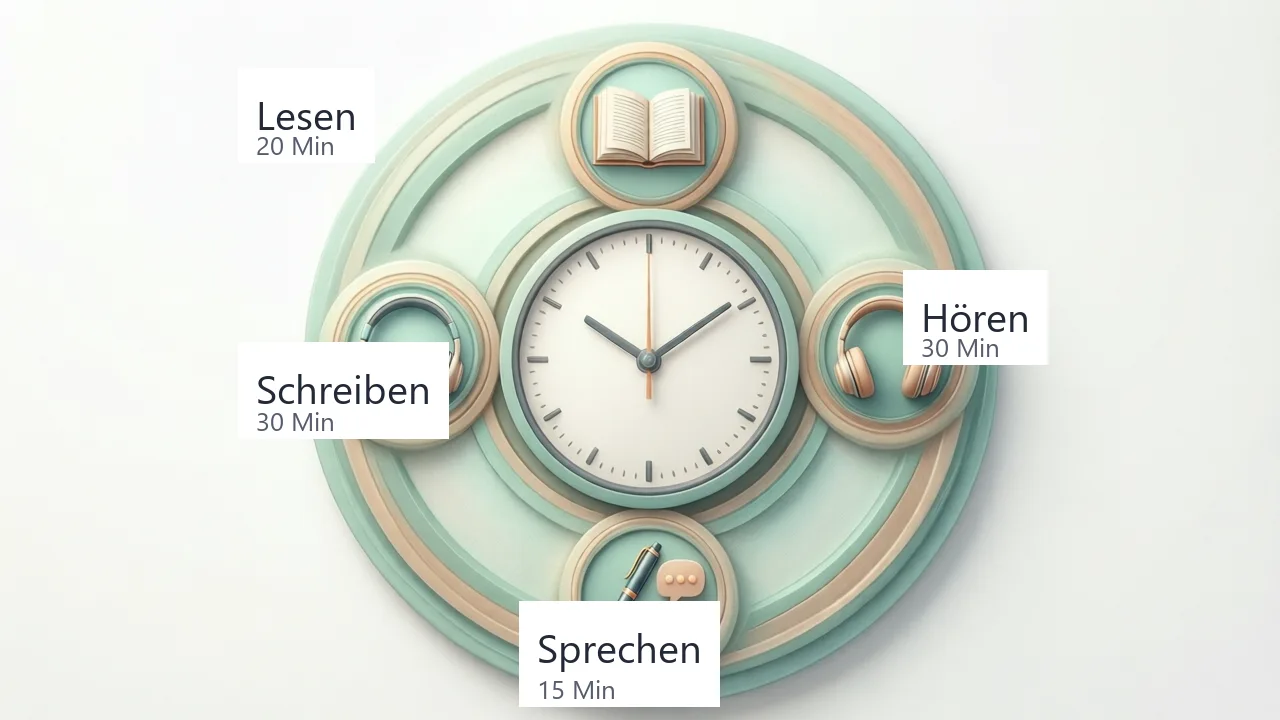
The whole exam typically runs about 100 to 120 minutes in one sitting, once you add seating, identity checks and module transitions. On paper per module: Lesen ~20 minutes, Hören ~30 minutes, Schreiben ~30 minutes, Sprechen ~15 minutes. Most Munich centres schedule you for a morning block, so plan half a day.
How is the DTZ graded?
The DTZ is scaled differently than the Goethe exam. For citizenship the requirement is simply B1: you need to pass the exam as a whole, which in practice means passing the exam as a whole, not necessarily every single module perfectly. Many candidates pass with a strong Lesen and Hören while Sprechen or Schreiben is borderline.
| Module | Time | What you do | Pass flavour |
|---|---|---|---|
| Lesen | ~20 Min | Read short texts, pick the right answer | Friendly to faster readers |
| Hören | ~30 Min | Announcements, weather, announcements again | This is the merciless one |
| Schreiben | ~30 Min | Write a short formal message (150-200 words) | Structure beats vocabulary |
| Sprechen | ~15 Min | Talk about everyday situations, describe a picture | Warm up before you arrive |
Can I retake it if I fail?
Yes, and honestly, most people who need it pass on the second try. You can retake as soon as another exam date has free seats. Take it as feedback, not as a verdict. Your weak modules are exactly where you can still gain points with targeted work.
The Einbürgerungstest: civics, but only 33 questions
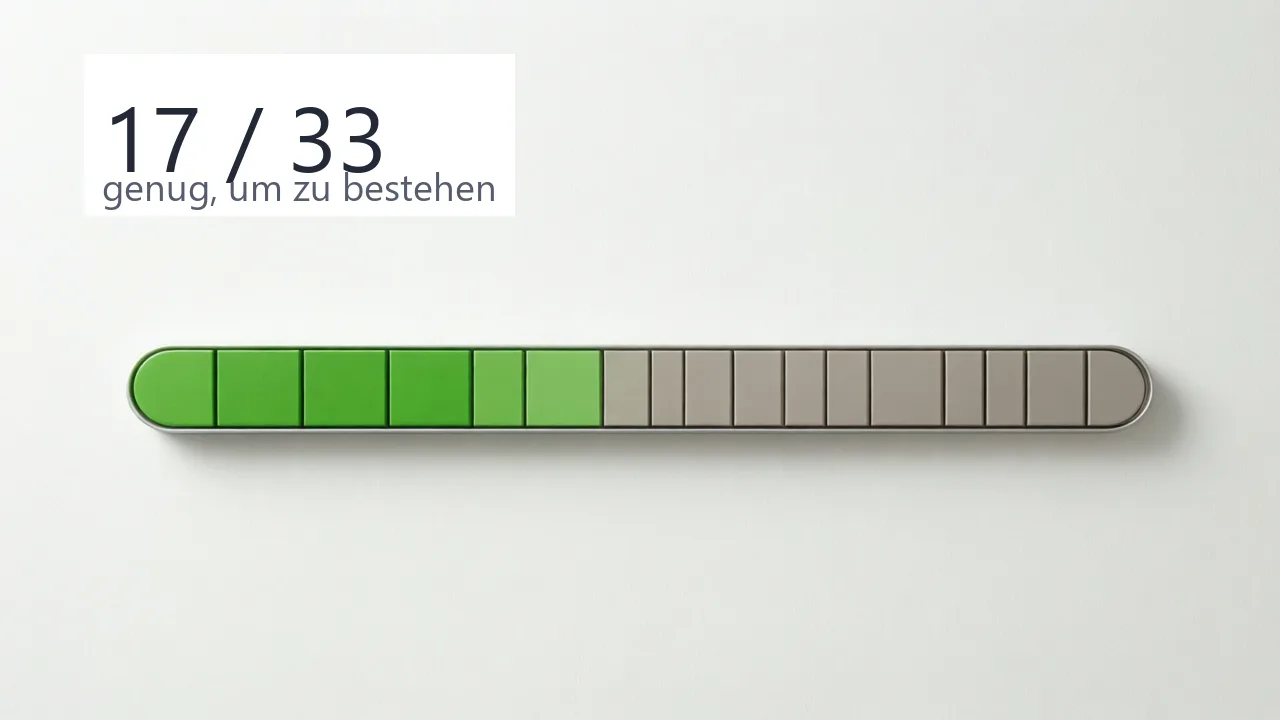
The Einbürgerungstest is not a language test. It checks that you know German life: history, politics, Grundgesetz, everyday rules like school attendance, right to vote, the Reichstag, the flag colours, weekend silence in apartment houses, that sort of thing. Format: 33 multiple choice questions, 60 minutes, you need 17 correct to pass. The result stays valid for your entire application file.
What kind of questions actually appear?
Most questions come from a public pool of 300 questions that the BAMF publishes. People I have prepared always say the same once they flip through the catalogue: roughly two thirds feel like things you absorb by living here, the rest you genuinely need to memorise. The catalogue itself with sample questions is on the BAMF Einbürgerungstest practice app. Treat it like flashcards, read each question slowly twice.
Who is exempt from the test?
Children born in Germany, and people who already hold a German school certificate proving equivalent knowledge (like a Realschulabschluss) do not need to sit the Einbürgerungstest. If that is you, skip this test, but hand the school document to the Beamte before the appointment.
Where do I sit the exams in Munich?
For the DTZ you book at a registered Prüfzentrum. Official information sits on the BAMF Abschlussprüfung page, where you find the list of exam centres with dates across Munich. For the Einbürgerungstest you go directly to the Municipal Citizenship Office in Munich once your naturalisation file is opened. I have seen people arrive on the wrong day, so read the invitation letter carefully and add the date to your phone the moment it arrives.
Worried about the B1 speaking part? Normal.
Honestly, most of my students come in thinking Lesen will be easy and Sprechen will be fine, then discover Hören is the wall. If you want to know in 20 minutes where your German stands, start with the free exercises and the B1 test on my site, that gives you a quiet baseline before you book an exam date.
If you want a focused push, we can sort this in a short cycle
The DTZ asks for a specific skill set that everyday German classes do not always teach: fast announcement listening, structured formal writing under 200 words, clear picture descriptions. That is exactly what my exam preparation course for German tests is built for, and for citizenship candidates we compress it into a short cycle so you can pass on the first or second attempt instead of the third.
FAQ
What is the difference between DTZ and Einbürgerungstest?
The DTZ proves your German level (B1). The Einbürgerungstest proves your civic knowledge of Germany. You normally need both certificates for naturalisation, but they are separate exams on different days.
How many mistakes can I make in the Einbürgerungstest?
You may miss up to 16 of 33 questions and still pass, since 17 correct answers is the threshold. Most of my students pass with 25 to 30 correct after one serious reading round of the catalogue.
Can I take the Einbürgerungstest in my native language?
No, the test is only offered in German. If you are exempt from the language test for school reasons, you might still need to prove civics through a translated interview with the Beamte instead, which the office decides per case.